
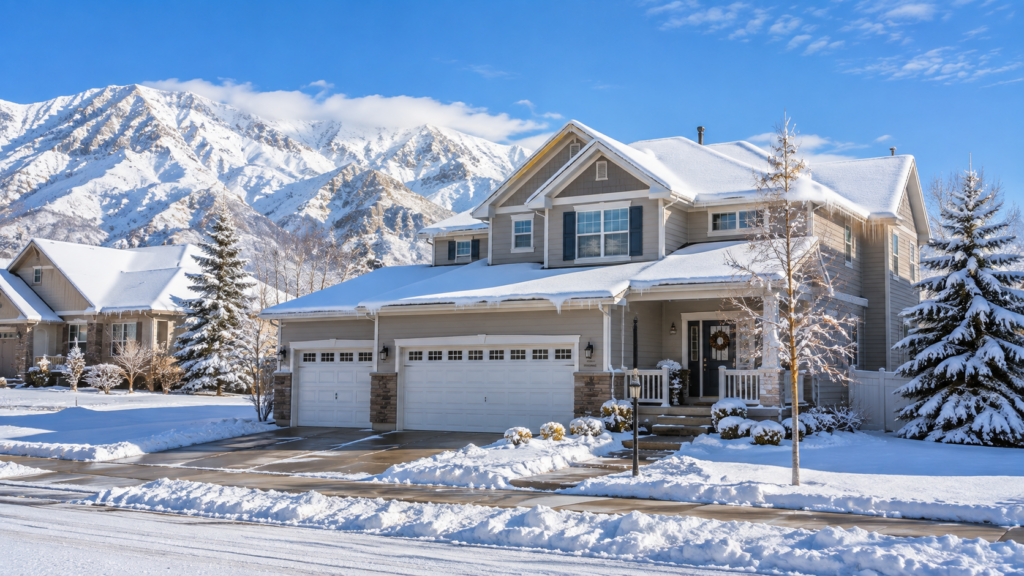
Every few winters in Utah, we hear news stories about a garage roof collapsing under snow. A barn caves in. A commercial flat roof develops a scary sag. And for the week after, our phones ring with anxious homeowners asking a very fair question:
“Is my roof safe?”
The good news: modern Utah homes are engineered for the snow load a Utah roof is expected to handle. The bad news: not every roof is a modern home, snow doesn’t always distribute evenly, and there are specific warning signs that homeowners should know how to spot.
After 25-plus years of working on Utah roofs, here’s what you actually need to know about snow load on a Utah roof, when to worry, and when to take action.
The Basics: What Is Snow Load on a Utah Roof?
Snow load is the weight of accumulated snow (and any ice, water, and drift) sitting on your roof, measured in pounds per square foot.
A few reference numbers to make this concrete:
- Fresh light snow: 5–7 pounds per cubic foot
- Settled snow: 15–20 pounds per cubic foot
- Wet or packed snow: 20–30 pounds per cubic foot
- Ice: 57 pounds per cubic foot
That means a foot of fresh powder over your entire roof is manageable, but that same foot of snow, packed and iced after several thaw-freeze cycles, might weigh three to five times more. And if wind has drifted it into piles two or three feet deep in one spot? That’s where trouble starts.
Snow Load Utah Roof Requirements By Area
Utah building codes set minimum snow load design requirements for every Utah roof, and they vary by location and elevation. The snow load Utah roof design values you’ll see in code are, roughly:
- Salt Lake Valley (Salt Lake City, Sandy, Draper, Riverton): 30 pounds per square foot minimum
- Utah Valley (Provo, Orem, Lehi, Eagle Mountain): 30 pounds per square foot minimum
- Higher elevations (Park City, Alpine, Cedar Hills): 60 to 90 pounds per square foot
- Mountain resort areas (Deer Valley, Sundance, Solitude): 90 to 200+ pounds per square foot
These are minimums. Homes built to code should safely handle these loads with a standard safety margin built in. The Utah Snow Load Study from the Structural Engineers Association of Utah is the authoritative reference for the numbers used in Utah building code, and your local building department can confirm the specific design load for your address.
Important caveat: these are the design loads for the building itself. They assume even snow distribution. Drift loads (snow piling up in a specific area due to wind or roof shape) can be dramatically higher and are where most snow-related roof failures actually happen.
When Snow Load on Your Utah Roof Becomes a Problem
Homes engineered to modern Utah code rarely fail from evenly distributed snow. Failures happen from:
Drift loads. Wind piles snow against walls, chimneys, dormers, and the low side of stepped roof sections. A drift can be 4 to 8 feet deep in a spot where the surrounding roof has 2 feet.
Ice damming. Ice buildup at eaves adds significant weight and creates leverage on the roof edge. Combined with snow load, this concentrates stress at vulnerable areas.
Repeated freeze-thaw cycles. Snow that melts and refreezes gets progressively denser and heavier. A season’s worth of snow that’s been through 10 freeze-thaw cycles weighs far more than the same volume of fresh snow.
Older homes. Homes built before modern code (roughly pre-1990) may not meet current snow load standards. Additions and remodels are especially variable.
Non-permitted structures. Garages, carports, shops, and additions built without permits or engineering may not be designed for real Utah snow loads.
Compromised structure. Water damage, rot, previous fire damage, termite damage, or DIY modifications can weaken a roof that was originally engineered correctly.
Flat and low-slope roofs. Snow doesn’t shed. It accumulates. Flat roofs bear the full weight indefinitely.
Warning Signs Your Utah Roof May Be Overloaded By Snow Load
If you’ve had heavy snowfall — especially wet, dense snow or rapid accumulation — walk through your house and look for these signs that snow load on your Utah roof is becoming a real problem:
Interior signs:
- Doors that suddenly stick or don’t close properly (frame deformation from roof deflection)
- New cracks in interior drywall, especially at door and window corners on upper floors
- Cracking, popping, or creaking sounds from the roof structure
- Sagging or bowing ceilings
- Visible bowing in exposed roof beams or trusses in attics or vaulted ceilings
Exterior signs:
- Visibly sagging roof line where the ridge line dips or the eaves droop
- Snow depths over 2 feet on the roof, especially wet packed snow
- Ice dams at the eaves contributing significant additional weight
- Snow drifting to depths of 4+ feet against walls or in valleys
- Water leaking inside during snow melt (indicates ice damming, not necessarily structural, but worth investigating)
If you see any of the interior signs above, take it seriously. Evacuate the affected area of the house, don’t ignore it, and call a professional the same day.
Snow Removal: When and How to Reduce Snow Load on a Utah Roof
Most homeowners never need to remove snow from their roof. Modern homes are built to handle it. But there are situations where removing snow to reduce snow load on a Utah roof is smart:
When to consider snow removal:
- Accumulation exceeds 2 feet on a pitched roof
- Accumulation exceeds 1 foot of wet snow on a flat roof
- Ice damming is severe
- Warning signs (sagging, cracks, sounds) are appearing
- Your home is older or you have any doubt about structural capacity
- A large storm is forecast to hit an already-loaded roof
How to do it safely:
From the ground (safest, always try first):
- Use a roof rake — a long-handled tool designed to pull snow off the lower few feet of the roof
- Focus on the lower 4 to 6 feet of the roof, especially at eaves where ice dams form
- Never try to remove ALL the snow — a thin layer is fine and pulling everything down risks damaging the roof surface
From the roof (only if absolutely necessary and you have safety equipment):
- Don’t do this. Seriously. Roof snow removal is one of the most dangerous DIY activities in winter. Every year in Utah, homeowners fall and get seriously hurt or killed.
- Hire a professional. Roofing companies, snow removal services, and some property maintenance companies do this work safely with proper equipment.
What NOT to do:
- Don’t use metal shovels — they damage shingles, tile, and metal roofing
- Don’t use ice picks or hammers — same reason
- Don’t use rock salt or sodium chloride — it corrodes shingles, metal flashing, and gutters
- Don’t use a heat torch — this is how houses catch fire in winter, and it happens in Utah every year
- Don’t walk on a snow-covered roof — you can’t see what you’re stepping on and slip risk is severe
Roof Design and How It Affects Snow Load Utah Roof Performance
Some roof designs handle snow load on a Utah roof better than others:
Steep pitched roofs shed snow. A 6/12 pitch or steeper will naturally shed a lot of snow before it accumulates dangerously.
Metal roofs shed snow faster than tile or shingle. Snow slides off metal easily. This can actually be a problem — snow can slide off in dangerous sheets, which is why snow guards or snow bars are commonly installed above walkways and entries.
Complex roofs with valleys and dormers accumulate more. Snow gets trapped in valleys, drifts against dormers, and creates uneven loading.
Flat roofs hold everything. No shed. All snow accumulates until you remove it or it melts.
Wide overhangs are drift magnets. Eaves that project several feet can accumulate significant drift.
If you’re planning a new home or a re-roof and you want to minimize snow issues, talk to your roofer about material choice, snow guards, and roof design considerations.
When to Get a Professional Snow Load Inspection
Get your roof inspected:
- After any exceptionally heavy snow year. Even if nothing failed, stress on the structure may have caused issues.
- If you notice ANY of the interior warning signs above. Same day.
- When buying a home in Utah. Especially older homes. A roof and structure inspection should be part of the process.
- After any addition or modification. Make sure the new work is engineered for snow load.
- Every 3 to 5 years for older homes. Preventive inspection catches issues before they become emergencies.
A professional inspection includes attic and structural evaluation, not just looking at the shingles. If you’re just having someone look at the outside of the roof, you’re not getting a real snow load Utah roof assessment.
Frequently Asked Questions
How much snow load can a Utah roof hold?
Depends on when it was built and where. Salt Lake Valley homes to modern code are designed for at least 30 pounds per square foot. Higher-elevation homes are designed for 60–200+ pounds per square foot. Real-world capacity has some safety margin built in, but drift loading, older construction, and structural issues can all reduce actual capacity.
Should I remove snow from my Utah roof after every storm?
No. Most Utah homes are engineered for accumulated snow. Snow removal is only necessary in specific situations — extreme accumulation, wet packed snow exceeding 2 feet, visible warning signs, or older/questionable structures.
Can heavy snow damage my Utah roof even if it doesn’t collapse?
Yes. Prolonged snow load on a Utah roof stresses roofing materials, causes ice damming, damages gutters and fascia, and can push flashing loose. Chronic overload gradually weakens the structure even if it never fails catastrophically.
Does homeowners insurance cover roof collapse from snow load on a Utah roof?
Most standard Utah homeowners policies cover sudden collapse from snow and ice load. They typically don’t cover damage from gradual wear, poor maintenance, or pre-existing structural weakness. Document everything and call a reputable roofer for inspection before filing.
Are metal roofs better for snow load on a Utah roof than shingle?
For pure snow shedding, yes. Metal sheds snow readily rather than accumulating it. But this creates its own hazards — snow sliding off in sheets can damage landscaping, injure people, and pile up dangerously below eaves. Snow guards are commonly installed on metal roofs to control shed.
What’s a snow guard and do I need one?
Snow guards (also called snow bars or snow stops) are small brackets or bars installed on metal and slate roofs to hold snow in place and prevent dangerous slides. They’re typically installed above entries, walkways, driveways, and areas where sliding snow could cause harm. Most metal roofs in Utah residential use benefit from snow guards.
How do I know if my older home meets current snow load Utah roof code?
Have it inspected by a roofer familiar with Utah snow code, or by a structural engineer. Homes built after roughly 1990 generally meet current requirements. Homes built earlier may or may not, depending on when local codes were adopted and enforced.
Get Your Snow Load Utah Roof Assessed Before Next Winter
If you’re going into winter uncertain about your roof’s snow load capacity — especially if you have an older home, a recent addition, or you’ve noticed any warning signs from past winters — get it inspected now, before the snow flies.
We do free residential and commercial inspections across Utah. We’ll walk your roof, evaluate your structure and attic, and give you a straight answer about what your roof can handle and whether any preventive work makes sense.
Call our Utah team at (801) 828-0259 or request a free estimate online.
Written by Matt Baker, founder of Baker Roofing. Matt has been installing and repairing roofs across Arizona and Utah for over 25 years.
