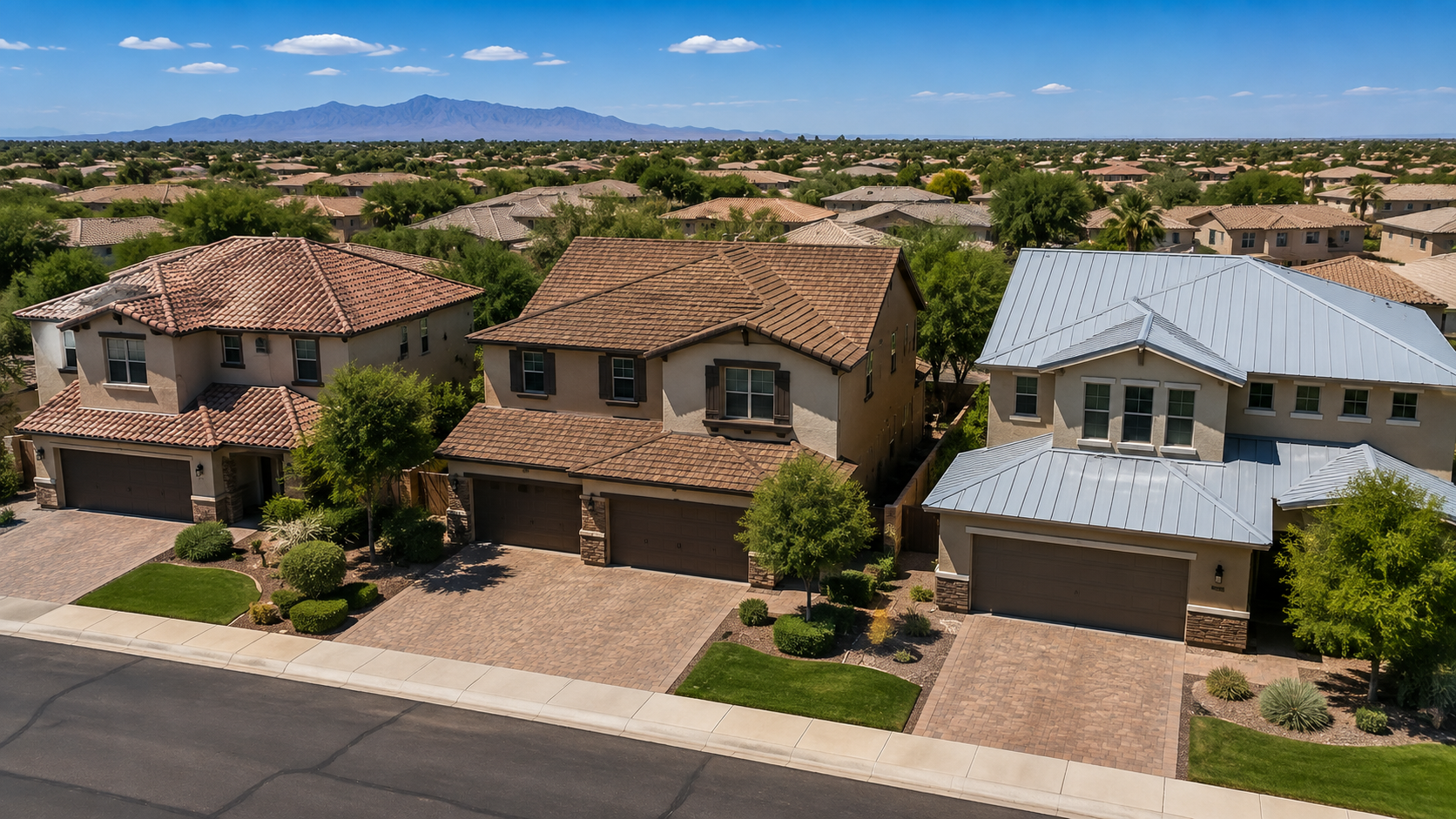
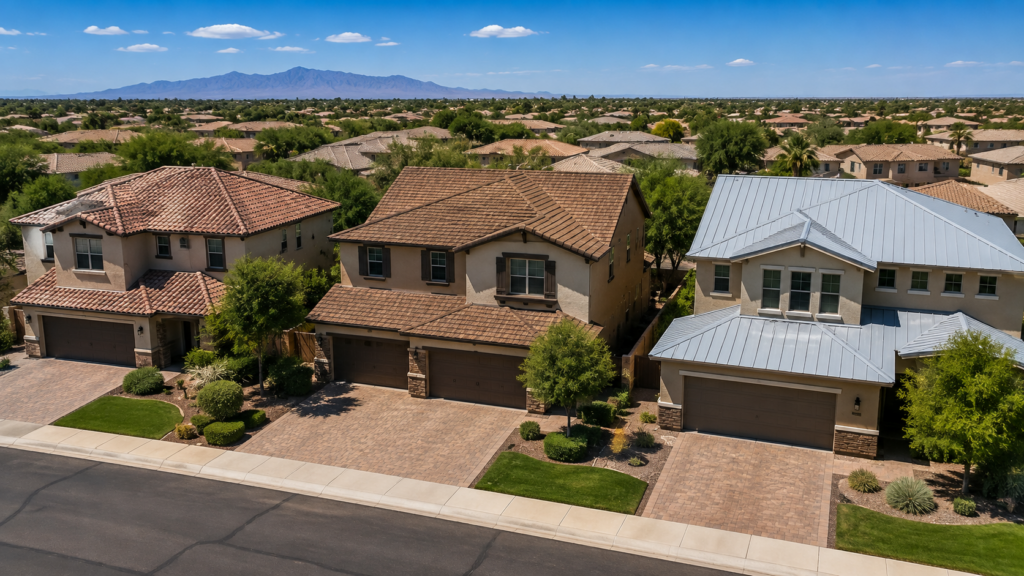
“What’s the best roof for my house?”
It’s the question we get more than any other, and the honest answer is: it depends. The best roofing materials for Arizona heat aren’t the same as the best roofing materials for Ohio or Oregon. And the best roof for your neighbor might not be the best roof for you.
Arizona homes deal with conditions most of the country doesn’t understand. 115-degree summer days. UV radiation that’s 30% higher than the national average. Monsoon storms with 60 mph winds and horizontal rain. Attic temperatures over 160°F. Homes with flat sections, pitched sections, and often both on the same roof. HOAs with strict material requirements. And a big gap between what’s “cheap” up front and what actually lasts.
After 25-plus years of installing every kind of roof material on Arizona homes, here’s an honest breakdown of the best roofing materials for Arizona heat and how to choose the right one for your home in 2026.
The Four Main Options in Arizona
Most Arizona homes get roofed with one of four materials:
- Concrete or clay tile (the regional standard)
- Asphalt shingle (the budget-friendly option)
- Metal (the long-term investment)
- Foam / SPF (for flat and low-slope sections)
Each has strengths, weaknesses, and specific homes where it makes sense. Let’s walk through them the way we’d walk through them at your kitchen table.
Concrete and Clay Tile
Investment level: Mid-to-high — more than asphalt shingle, typically less than metal Lifespan (tile itself): 40 to 50+ years Lifespan (underlayment underneath): 20 to 25 years for felt, 30+ for synthetic Best for: Most Phoenix-area homes, HOA-required tile neighborhoods, homeowners planning to stay long-term
Tile is the regional standard in Phoenix, Mesa, Gilbert, Queen Creek, and Scottsdale for a reason. It’s easily one of the best roofing materials for Arizona heat — it handles high temperatures well, looks great, and the tile itself lasts decades.
Why tile works so well in Arizona:
- Thermal mass. The thick tile absorbs heat slowly and releases it slowly, which moderates attic temperature swings.
- Air gap. Tile installations naturally have airflow between the tile and the underlayment, which further reduces heat transfer into the house.
- Fire resistance. Class A fire rating, which matters in the increasingly common wildland-urban interface areas of Arizona.
- Wind resistance. Properly installed tile handles monsoon winds well.
- Longevity. The tile itself may outlast the house.
Where tile falls short:
- Weight. Tile is heavy (roughly 900 pounds per square). It requires structural framing designed to support it. Not all homes originally built for shingle can be re-roofed with tile without engineering.
- Underlayment life. Tile is often oversold as “the tile roof lasts 50 years.” The tile does — the underlayment underneath fails at 20 to 25 years. Most Arizona tile roofs need underlayment replacement at some point in their life.
- Cost. Meaningfully more expensive up front than asphalt shingle.
- Cracking from foot traffic. Walking on tile improperly can crack it. Solar installers, HVAC techs, and other trades on your roof need to know how to walk tile.
S-tile vs. flat tile: Both are common in Arizona. S-tile (barrel-shaped) has more airflow and looks more traditional Southwestern. Flat tile has a cleaner modern look and is common on newer builds. Performance is similar; it’s mostly aesthetic and HOA-driven.
Asphalt Shingle
Investment level: Most budget-friendly of the common Arizona roofing materials Lifespan in Arizona: 15 to 25 years (less than manufacturer ratings due to heat) Best for: Budget-conscious homeowners, non-HOA neighborhoods, simple roof shapes
Shingles are the cheapest option and the fastest to install. Among the best roofing materials for Arizona heat when budget is the driver, quality architectural shingles are a fine choice for many homes — especially in neighborhoods that don’t require tile.
Why shingle works in Arizona:
- Cost. The most affordable of the common Arizona roofing options.
- Fast installation. A shingle re-roof can be done in 1 to 2 days on a typical home.
- Easy repairs. Damaged shingles are simple and cheap to replace.
- Broad color and style selection. Architectural shingles come in many looks.
- Impact-rated options. Class 4 impact-rated shingles offer better hail and debris resistance and sometimes qualify for insurance discounts.
Where shingle falls short in Arizona:
- UV degradation. Arizona sun is brutal on asphalt. Shingles that would last 30 years in Ohio last 15 to 20 in Phoenix.
- Heat absorption. Dark shingles absorb enormous amounts of heat, which drives up cooling costs.
- Less aesthetic prestige. In tile-standard neighborhoods, shingle can look out of place.
- Wind vulnerability. Cheap 3-tab shingles can lift in monsoon winds. Architectural shingles handle wind better but still not as well as tile.
If you’re going shingle in Arizona: Spring for architectural grade (not the cheapest 3-tab), consider a “cool roof” line rated for high solar reflectance, and if possible, choose a lighter color to reduce heat absorption. You can browse ENERGY STAR-certified reflective roof products at the ENERGY STAR roof products database to compare specific brands.
Metal Roofing
Investment level: Highest upfront cost of the common Arizona roofing materials Lifespan: 40 to 70 years Best for: Custom homes, long-term homeowners, modern architectural styles, fire-prone areas, homeowners who prioritize energy efficiency
Metal is the most expensive option up front but the longest-lasting and most energy-efficient. In the pure performance sense, it’s arguably the best of the best roofing materials for Arizona heat — provided it fits your home and your budget.
Why metal shines in Arizona:
- Heat reflection. Modern metal roofing with reflective coatings can reflect 65 to 85% of solar radiation. Studies show cooling bill reductions of 10 to 25% versus dark asphalt shingle.
- Longevity. Standing seam metal can outlast the house.
- Fire resistance. Class A rated. Excellent in wildland areas.
- Wind resistance. Rated for high wind speeds when properly installed.
- No cracking or breaking. Unlike tile, metal doesn’t shatter under impact.
- Snow shed. Not usually relevant in Phoenix but matters at higher elevations (Flagstaff, Prescott).
Where metal falls short:
- Cost. The highest upfront investment of any common roofing material.
- Aesthetic fit. Metal doesn’t work with every architectural style. Many HOAs in central Phoenix neighborhoods don’t allow it.
- Noise. Rain and hail on metal is louder than on tile or shingle — but proper underlayment and attic insulation reduce this significantly.
- Installation quality is critical. A poorly installed metal roof leaks. Metal-specific experience matters enormously in your installer.
- Denting from hail. Standing seam is resistant, but severe hail can dent softer metal profiles.
Metal roof types common in Arizona:
- Standing seam — clean modern look, best long-term performance
- Corrugated / R-panel — more industrial look, most economical metal option
- Stone-coated steel — metal with the aesthetic of tile or shingle, gaining popularity
Foam Roofing (SPF) for Flat Sections
Investment level: Mid-range material cost, but usually only applied to smaller flat sections of a roof Lifespan: 15 to 25 years with periodic recoating Best for: Flat and low-slope sections of Arizona homes
Many Arizona homes have flat or low-slope sections — entryways, additions, garages, patios — that can’t use sloped materials. Sprayed polyurethane foam (SPF) is the dominant solution and one of the best roofing materials for Arizona heat on flat sections specifically.
Why foam works on flat Arizona roofs:
- Seamless application. Foam is sprayed on and cures into a monolithic waterproof membrane with no seams to fail.
- Insulation value. Adds R-value to the roof, reducing heat transfer.
- Reflective coating. Foam is topped with a highly reflective elastomeric coating (usually white) that dramatically reduces heat absorption.
- Repairable. Damage can be spot-patched easily.
- Recoat-able. Every 5 to 10 years, the reflective coating is renewed, extending the life of the entire system.
Where foam falls short:
- UV degradation of coating. The reflective topcoat needs periodic renewal.
- Susceptible to physical damage. Foot traffic, tools, and debris can puncture or dent foam.
- Not suitable for pitched roofs. Foam is only used on flat or low-slope sections.
- Requires proper drainage. Flat roofs must be sloped enough to shed water. If ponding occurs, foam life shortens.
For a Phoenix home with mixed roof sections (some pitched, some flat), a typical solution is tile or shingle on the pitched sections and foam on the flat sections.
What About “Cool Roofs”?
You’ll hear this term a lot in Arizona marketing. “Cool roof” isn’t a specific material — it’s any roofing system that reflects more sunlight and absorbs less heat than a standard roof. Any of the best roofing materials for Arizona heat can be spec’d as a cool roof.
Cool roof options include:
- Light-colored asphalt shingles with reflective granules
- White or light-colored tile
- Reflective metal roofing
- White elastomeric coatings on foam or existing roofs
The energy savings can be real, especially on homes without much attic insulation. Utility rebates are sometimes available for qualifying cool roof installations — check with APS or SRP for current programs.
Matching Material to Situation
Here’s how we help homeowners think through the decision:
You’re planning to sell in the next 5 years: Match what the neighborhood expects. In tile neighborhoods, install tile. In shingle neighborhoods, quality architectural shingle. Don’t overspend on premium materials you won’t recoup.
You’re staying 10+ years: Consider metal or tile. The higher upfront cost pays off in longevity and energy savings over time.
You’re on a tight budget: Quality architectural shingle from a name-brand manufacturer. Skip the premium options. Focus on quality installation and workmanship warranty.
You have mixed roof sections: Tile or shingle on the pitched parts, foam on the flat parts. This is the most common Arizona setup.
You’re in a wildfire-prone area: Metal or tile. Both are Class A fire-rated. Modern building codes in Arizona’s WUI areas may require this.
Your HOA has strict rules: Start by checking what’s allowed, then optimize within those constraints.
The Underrated Factors
A few things that matter more than most homeowners realize:
Underlayment quality. Under any roofing material, the underlayment is what actually keeps water out. In Arizona heat, spec the highest-quality synthetic underlayment your budget allows. The cost difference is small; the lifespan difference is significant.
Attic ventilation. No roof material can compensate for a poorly ventilated attic. Adequate soffit intake and ridge exhaust dramatically extend roof life and reduce cooling bills.
Installation quality. A great material installed poorly performs worse than a mid-tier material installed well. Vet your installer’s experience with the specific material you’re choosing.
Manufacturer warranty registration. Some companies skip this step. Make sure your roofer registers the warranty and gives you documentation.
Frequently Asked Questions
What are the best roofing materials for Arizona heat overall?
There’s no single answer, but the strongest performers are metal (best heat reflection and longevity), concrete or clay tile (best regional fit for most Phoenix-area homes), and white foam (best for flat sections). Architectural asphalt shingle in a light color is the best budget-friendly choice.
What roofing material lasts the longest in Arizona?
Standing seam metal (40 to 70 years) and clay tile (50+ years) are the longest-lasting materials. Concrete tile lasts 40 to 50 years. Asphalt shingle lasts 15 to 25 years. Foam lasts 15 to 25 years with periodic recoating.
What’s the most energy-efficient roof for Phoenix?
Reflective metal roofing and white foam roofing offer the highest solar reflectance and best cooling performance. Tile is a distant third but still outperforms dark asphalt shingle. Light-colored materials always beat dark ones for cooling efficiency in Phoenix.
Can I put a metal roof over my existing shingle roof?
Sometimes, but it’s rarely a good idea in Arizona. Underlying moisture, existing damage, and unknown deck condition all get sealed under the new roof. Full tear-off gives you a clean start and lets your roofer address any hidden issues.
What’s the cheapest roofing material for Arizona?
Asphalt shingle is generally the most budget-friendly option up front. But cheapest upfront isn’t always cheapest overall — shorter lifespan in Arizona heat means you’ll replace it sooner than tile or metal.
Do white roofs really save money in Arizona?
Yes, meaningfully. Studies of white and reflective roofs in the Phoenix area show 10 to 20% reductions in summer cooling costs versus dark roofs. On homes with high summer electric bills, that adds up quickly over a full cooling season.
What roofing material is best for solar panels?
Standing seam metal is ideal because solar mounting clips attach without penetrating the roof. Tile can work but requires specialized mounting hardware and experienced installers. Shingle is the easiest for standard solar installation.
Are there rebates for energy-efficient roofs in Arizona?
Sometimes. Check with your utility (APS, SRP, TEP, or others) for current cool roof and energy efficiency rebate programs. Federal energy efficiency tax credits also periodically apply to qualifying roofing materials.
Get Personalized Guidance on the Best Roofing Materials for Your Arizona Home
The right material for your home depends on your budget, your neighborhood, your architectural style, and how long you plan to stay. There’s no substitute for having a knowledgeable roofer walk your specific property and talk through the options honestly.
We do free consultations across the Valley. We’ll help you weigh the trade-offs and give you a straight quote for the materials that make sense for your situation — no pressure, no sales pitch.
Call our Arizona team at (928) 965-7857 or request a free estimate online.
Written by Matt Baker, founder of Baker Roofing. Matt has been installing and repairing roofs across Arizona and Utah for over 25 years.
