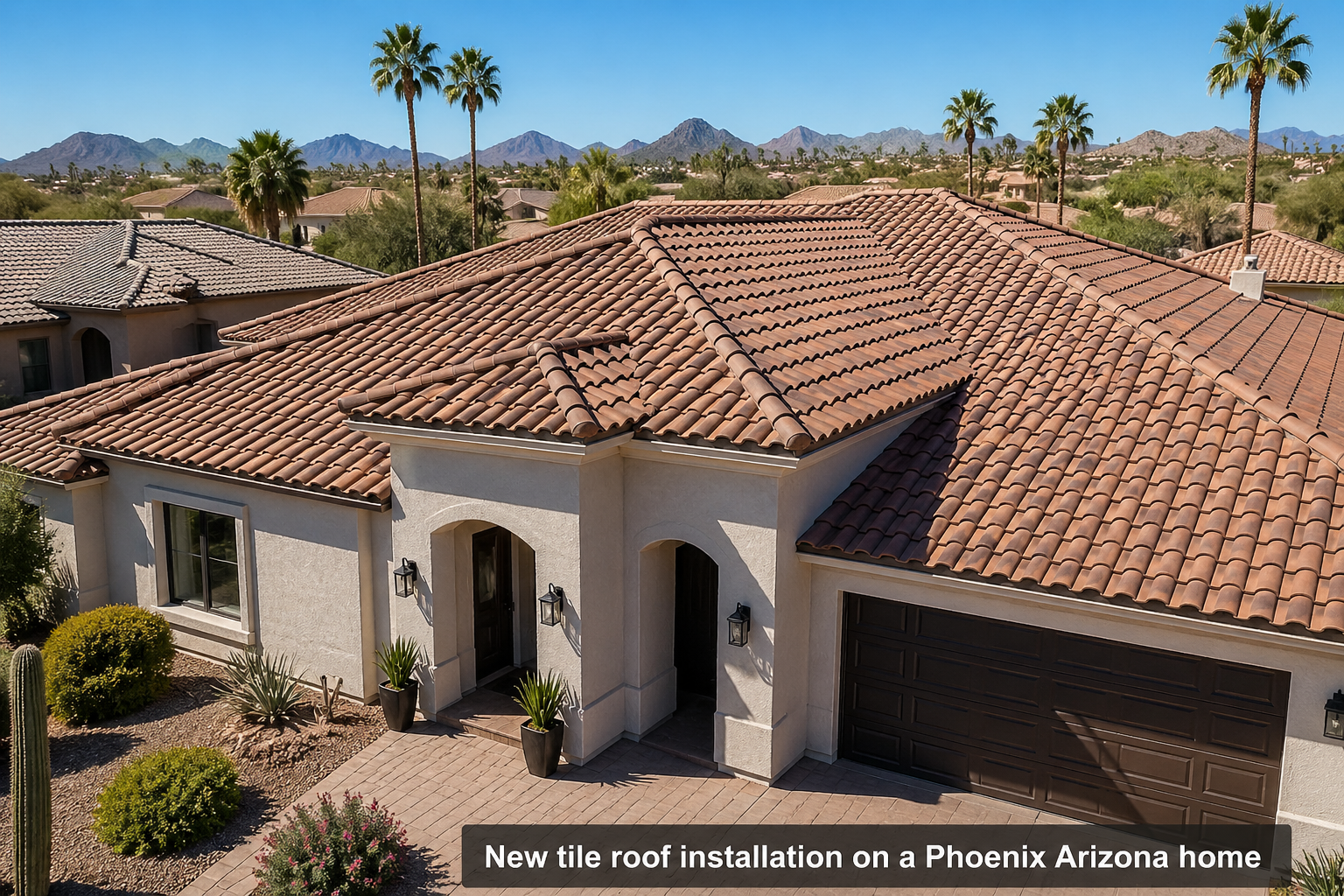
If you’re staring down a new roof in Phoenix, the first quote you get is probably going to sting. And the second one. And the third one. Roofing prices have climbed steadily over the last few years, driven by material costs, labor, and the simple fact that Arizona sun is harder on roofs than most of the country, so we use heavier-duty materials than a roofer in, say, Ohio would.
But “expensive” doesn’t mean you’re getting ripped off. It just means roof replacement is a real investment, and like any real investment, it pays to understand what you’re actually paying for.
After 25+ years of putting roofs on Phoenix-area homes, here’s what we tell our customers when they ask us the cost question. We’ll go through realistic 2026 price ranges, what actually moves the number up or down, and a few things to watch out for in any estimate you get.
The Quick Answer
For a typical single-family home in the Phoenix area (around 2,000 square feet of living space, with roughly 22 to 28 “squares” of roofing surface), here’s what to expect in 2026:
- Asphalt shingle roof: $11,000 to $19,000
- Concrete or clay tile roof: $20,000 to $38,000
- Standing seam metal roof: $25,000 to $45,000
- Foam roof on flat or low-slope sections: $7 to $12 per square foot
These are full-replacement numbers. Tear off the old roof, install new underlayment, install the new roofing, haul away the debris. Repairs are obviously much cheaper, and we’ll get into the line items shortly.
If your house is bigger, more complex, or your old roof has problems hidden under the surface, expect to land at the higher end. If it’s a straightforward replacement on a smaller home, you’ll be closer to the low end.
Why Phoenix Roofs Cost What They Cost
Roofing is local. A roof in Minnesota is a different beast than a roof in Phoenix, and the materials, codes, and labor reflect that.
A few things specific to the Valley drive our pricing:
Heat is the enemy. Phoenix sees more 110°F-plus days than almost anywhere in the country. Roofing materials degrade faster here. That means we use heavier-grade underlayments, higher-rated shingle classifications, and better fasteners than you’d see in milder climates. The materials cost more up front, but a “cheap” Phoenix roof tends to fail in 8 to 12 years instead of lasting 20-plus.
Tile is the regional standard. Most homes in Phoenix, Mesa, Gilbert, Queen Creek, and Scottsdale have concrete tile roofs. Tile is heavier, more labor-intensive, and requires specific underlayment systems. That’s why tile roofs cost roughly double what shingle roofs cost.
Monsoon season demands quality. The wind, rain, and debris that come through every July and August find any weakness in a roof. Cutting corners on flashing, valleys, or fastening will cost you in the first big storm.
Permits and code. Cities across the Valley have varying permit requirements. Permits run $200 to $600 in most cases, and some HOAs add their own review process that can affect timing.
Cost By Roofing Material
Asphalt Shingles
- Cost installed: $5 to $8 per square foot
- Lifespan in Phoenix: 15 to 25 years (less than the manufacturer rating because of heat)
- Best for: Budget-conscious homeowners, simple roof shapes, neighborhoods that allow shingle (some HOAs require tile)
Shingles are the cheapest option and the fastest to install. The major brands — GAF, Owens Corning, CertainTeed — all make “cool roof” or high-reflectance lines specifically rated for desert heat. If you go shingle in Phoenix, spring for the architectural grade, not the cheapest 3-tab. The price difference is small. The lifespan difference is significant.
Concrete and Clay Tile
- Cost installed: $9 to $15 per square foot
- Lifespan: 40 to 50 years for the tile itself (the underlayment underneath needs replacement every 20 to 25 years)
- Best for: Most Phoenix-area homes — it’s the regional standard for a reason
Tile is the workhorse of Arizona roofing. It handles heat well, looks great, and lasts decades. Here’s something most homeowners don’t realize: when people say “I need a new tile roof,” they usually don’t need new tile. They need new underlayment. The tile itself often gets reused. A “tile reset” job — pulling the tile, replacing the underlayment, putting the tile back — costs roughly $7 to $11 per square foot, which is meaningfully less than full replacement.
If tiles are broken, missing, or you want a different look, that’s when full tile replacement comes into play.
Metal Roofing
- Cost installed: $11 to $20 per square foot
- Lifespan: 40 to 70 years
- Best for: Homeowners staying long-term, custom homes, modern aesthetic, fire-prone areas
Metal is the most expensive option up front but the longest-lasting. Standing seam metal in Phoenix can outlast the house itself if installed well. Heat reflection is excellent — it can drop summer cooling bills 10 to 25% compared to dark shingle. The catch: not every home looks right with metal, and most HOAs in central Phoenix neighborhoods don’t allow it. It’s more common on custom homes, new builds, and outlying areas.
Foam (SPF) for Flat Sections
- Cost installed: $7 to $12 per square foot
- Lifespan: 15 to 25 years with periodic recoating
Many Phoenix homes have flat or low-slope sections — entryways, additions, garages — that can’t use sloped materials. Sprayed polyurethane foam is the most common solution. It’s not cheap per square foot, but you usually only need it on smaller sections.
What Else Drives the Cost
Material is a big chunk of the bill, but plenty of other line items matter:
Square footage of roof, not house. Roofing is priced per “square” (100 square feet of roof surface). Your roof is bigger than your living space because of overhangs, slope, and any flat sections.
Tear-off vs. overlay. Most Phoenix roofs require full tear-off. Code and material warranties usually mandate it. If anyone offers you a deal to “just go over the existing roof” — be very cautious. It’s rarely a good idea here.
Decking repair. Once we tear off, sometimes we find rotted plywood, water damage, or termite issues. Replacing decking adds $2.50 to $4.50 per square foot of damaged area. A reputable roofer should give you an estimate that includes a decking allowance with clear pricing if more is needed.
Underlayment quality. This is where bad estimates hide. Cheap synthetic vs. high-quality felt with ice-and-water shield can be a $1,500-plus difference on the same job. In Phoenix heat, this matters enormously to lifespan.
Slope and complexity. A simple gable roof with two planes is much cheaper to roof than a cut-up roof with valleys, dormers, and multiple sections. Steeper pitches require safety equipment and slow the work down.
Accessibility. A two-story home with limited access, a tile roof on a hillside, or a property with no staging area all add labor cost.
Hidden Costs to Watch For
After 25 years of writing estimates, here are the most common ways homeowners get surprised:
- Decking allowance vs. actual replacement. A low estimate that says “decking repair as needed at $X per sheet” sounds fine until you have 30 sheets to replace. Ask what the average is on similar homes in your neighborhood.
- Ridge venting and ventilation. Phoenix attics can hit 160°F-plus in summer. If your old roof had inadequate ventilation, the new install should fix it — and that cost should be in the estimate, not a surprise.
- Flashing. New roof, old flashing is a recipe for leaks. Make sure new flashing around chimneys, vents, skylights, and walls is included.
- Disposal. Should be included. If it’s not, that’s a flag.
- Manufacturer warranty registration. Some companies skip this step, which voids your material warranty. Make sure your roofer registers it after install and gives you the documentation.
How to Get an Honest Estimate
Here’s how we recommend Phoenix homeowners approach the bidding process:
- Get three estimates. Not five. Three. More than that just creates noise.
- Make sure they’re comparable. All three should be quoting the same material grade, tear-off scope, decking allowance, and warranty. If one is dramatically cheaper, ask why. They’re either using lower-quality materials or skipping a step.
- Verify the contractor’s license and insurance. In Arizona, roofing contractors need an ROC license. You can verify it at azroc.gov. Insurance should include both general liability and worker’s comp.
- Ask about the crew. Are they employees or subcontracted day labor? It affects quality and accountability.
- Ask about both warranties. There are two: the material warranty (manufacturer) and the workmanship warranty (roofer). Both matter.
- Don’t pay 100% up front. A reasonable deposit is 10 to 30%. If a roofer wants the full amount before starting, walk away.
Insurance and Storm Damage
A meaningful percentage of roof replacements in Phoenix get paid by insurance after monsoon damage. If your roof is more than 10 years old and has visible monsoon-related damage — lifted shingles, broken tile, exposed underlayment — it’s worth having a reputable local roofer do an inspection before you call your insurance company. They can tell you whether you have a legitimate claim and what to document.
Be careful of door-knocking “storm chasers” after big monsoons. They show up after every major weather event, often from out of state, and disappear before warranty claims can be made. Stick with established local roofers.
Frequently Asked Questions
How long does a new roof installation take in Phoenix?
A standard shingle replacement on a 2,000-square-foot home takes 1 to 2 days. Tile replacement takes 3 to 5 days. Metal can take 4 to 7 days depending on complexity. Weather (especially monsoon) can extend timelines.
Is it cheaper to roof in summer or winter?
Phoenix doesn’t have a true off-season the way northern states do, but contractors are generally less booked in late fall and winter. You may find better availability and slightly better pricing from November through February. Mid-summer through monsoon season is peak demand.
Can I just repair my roof instead of replacing it?
Often, yes. A reputable roofer will tell you when repair is the right call. Replacement makes sense when the underlayment is at end of life, you have widespread damage, or you’ve already done multiple repairs. Rule of thumb: if repairs would cost more than 30% of replacement, it’s usually time to replace.
Does a new roof increase home value?
Yes, but not dollar-for-dollar. A new roof typically returns 60 to 70% of its cost in resale value, and more importantly, it makes the home easier to sell. Failed roofs are a top deal-killer in Phoenix real estate transactions.
What’s the best roofing material for Phoenix?
There’s no single best answer — it depends on your home, neighborhood, budget, and how long you’re staying. Tile is the safest default. Metal is the longest-lasting investment. Architectural shingle is the budget-friendly choice that still performs well.
Get a Real Estimate
Online price ranges only go so far. Every home is a little different. If you’d like a free, no-pressure inspection and a written estimate, we’d be glad to take a look. We’ve been roofing across the Valley for 25-plus years, and we’ll tell you straight whether you need a repair, a partial replacement, or a full new roof.
Call our Arizona team at (928) 965-7857 or request a free estimate online.
